|
February 4, 2010
When I lived in Wellington New Zealand I stayed in Hataitai close to, and in the shadow of, Mt Victoria. I used to walked around Evans Bay Parade that ran along the harbor's edge to the CBD. It was in Wellington that I started taking photographs and occasionally I would venture into Newton on a photographic trip.
I didn't have much idea of what I was doing at the time, but I've often wondered if those photographers who lived in the windy city and actively took photos would do in order to construct a historical representation of a disappearing city.
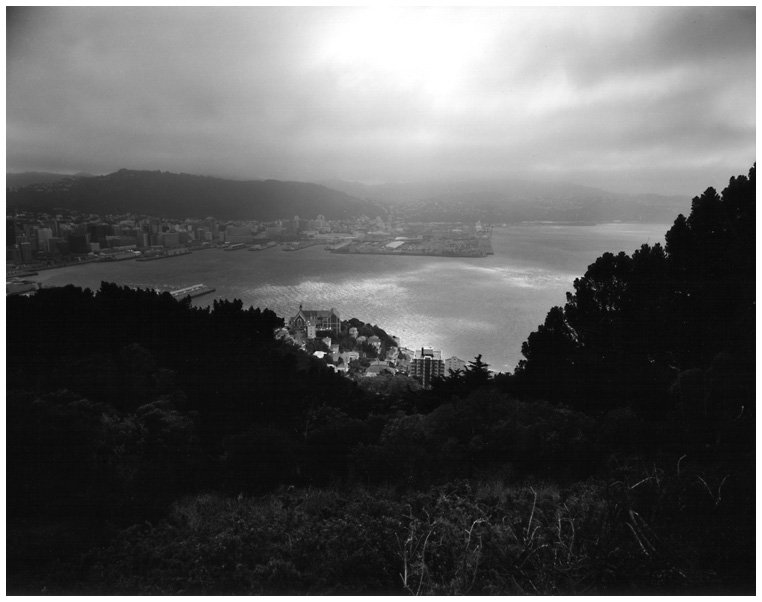 Andrew Ross, View from Mt.Victoria on a windy day, 29-3-98
I've just discovered that Andrew Ross, who lives in Newton, has done so. He has actively photographed Wellington's urban landscape since the early 1990s and started using large format equipment in 1996 and began the ongoing ‘Wellington Views’ series, a constantly growing photographic archive documenting the City and its environments. The emphasis is on those older buildings that are threatened with demolition or significant renovation, and the people who make their lives or livings in the buildings.
His ‘ act of salvage’ for buildings, both humble and significant, that continue to be lost is done with large format cameras ("8 x 10” and "4 x 5”), contact prints, and black and white. He has published a book entitled Fiat Lux that helps us to remember the fast fading past from different perspectives.
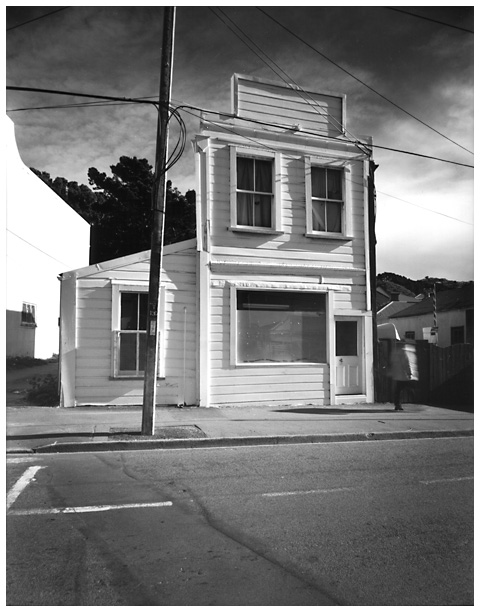 Andrew Ross, 248 Riddiford St, 1997
Fiat Lux is divided into five sections, each with text and images selected by a different writer/artist/curator and this gives us a good cross-section of his work. The overall spectre of urban development is expressed by this photograph of a two-storey wooden dwelling, which appears to be nothing but front, as though built for a filmset. The existence of the building looks decidely precarious.
|


