|
February 6, 2010
I'm preparing for a photographic road trip to Tasmania, starting Monday morning. It covers similar territory to my last trip that was done in 2006. But we are staying longer this time.
As a result I've begun to think about the intersection between photography and history, in a way that is outside the modernist history of photography that is marked by various, increasingly elaborate attempts to distinguish art photography from commercial and amateur productions; and from the documentary photography in bureaucratic institutions such as the police station, the insane asylum, the school and the prison.
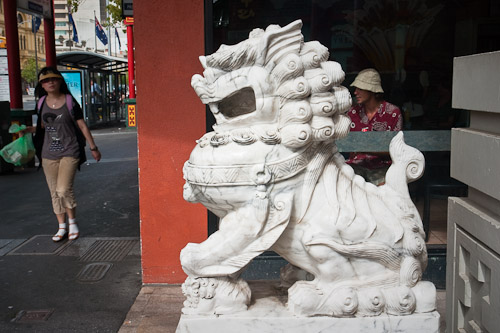 Gary Sauer-Thompson, China Town, Adelaide, 2010
For Walter Benjamin, the modern perception of "history" is inevitably experienced in a way that can only be described as photographic, partaking of photography's instantaneity and immediacy, its flash-like character, illuminative powers, its appearance as a fragment or temporal shard, its ambiguous status as both an image suspended in an ever-present and a concrete artifact of the past.
Eduardo Cadava in Words of Light: Theses on the Photography of History says "that photographic technology belongs to the physiognomy of historical thought means that there can be no thinking of history that is not at the same time a thinking of photography". Photography requires us to think about the impact of history on language as there is no word or image that is not haunted by history; or that history cannot occur without the event of language.
|


