|
January 7, 2011
I've stumbled across a project similar to my Port Adelaide one--it is by Frank Watson, and it is entitled Thames Gateway.
It is about the Thames Estuary, which is a marginalised site threatened not only by urban expansion----its transformation from marshland to new town as the Thames Gateway development --- but also rising sea levels. The Thames Estuary is a relatively flat landscape, lacking the traditional attributes of the picturesque.
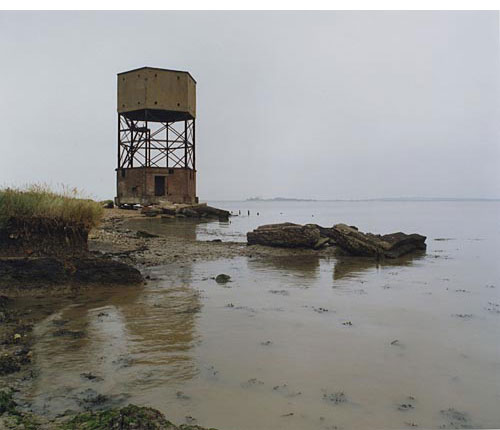 Frank Watson, military tower, 2008
This body of work forms part of Soundings From The Estuary, which is an ongoing project that is inspired by the Estuary's industrial, architectural, and maritime traces as well as the present threat to the existing terrain.
Watson's reference point is both the Modernist project, which he says corresponded with a period of radical change and looked towards the possibility and realisation of Utopia, and postmodernism which did much to kill off the idea of utopia as the modernist project. He adds:
Part of that hope has been superseded by fear, as the fallout of 19th and 20th century industrialisation is recognised and the repressed aspects of technological progress are confronted and the reparation of a rather damaged planet begins. A more pessimistic view acknowledges the impotence of this predicament and that we are already living in a world that resembles a 1960’s science fiction film.
He adds that the photographs in this exhibition articulate a sense of melancholy and abandonment that resonates at present in many areas of the estuary whilst at the same time also evoking uncanny predictions for the future of this part of England in light of climate threat.
|


