|
January 4, 2011
The horizonless landscape is the characteristic of Frederick Sommers' Arizona landscapes that were made between 1941 and 1947. In the image below the surface of the land rise to the edge of the photograph and there is no sky. Though the pictures’ textures are crisp and hard, the overall tone is a mid-grey, no single form dominates any other, and the land is a uniform flat surface.
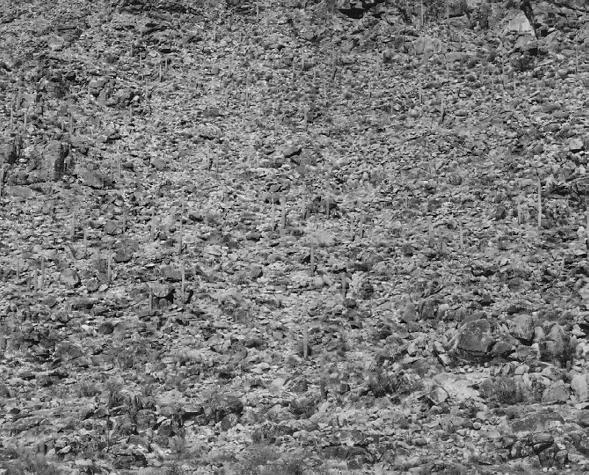 Frederick Sommer, Arizona Landscape, 1943, Gelatin silver print.
In this landscape there isn’t anything worth featuring with very little distinction between the plants and the rocks. This landscape just is. Yet Sommer is seen at standing at the crossroads of Surrealism and the photography of the American West—between Max Ernst and Edward Weston. Sommer's interpretation of the landscape that is at odds with the fundamentally positive view of the American West in that Sommer’s work represents the dark underbelly of American landscape photography ---a dry, dead and dying landscape.
How is this body of work related to European surrealism as opposed to formalism? Why is it so related?
Rosalind Krauss had opposed the concept of the “straight” photograph that had ruled the photography of certain American photographers of the thirties--- Edward Weston, Paul Strand and Ansel Adams—who emphasized authenticity and truth to materials to surrealism. Surrealist photography, wrote Krauss, was “a betrayal of photography’s vocation to constitute a faithful document”; it was contrived to the highest degree;” and that contrivance is what scandalizes ‘straight photography’.
In ‘As if one’s eyelids had been cut away’: Frederick Sommer’s Arizona Landscapes in the Journal of Surrealism and the Americas (2:2 2008) Ian Walker argues against this either or. He says:
Surrealism in Paris had been very securely sited within the city. But at the same time, there was a persistent fascination with the city’s “other”: nature at its most extreme— desert, forest and jungle. The only images of landscape created in Paris that begin to approach the unyielding vision of Sommer’s work are those originating in Spain— above all, the rocks of the Spanish coast at Cadaqués, as they appear in Salvador Dalí’s painting. However, even these landscapes cannot attain the starkness of the Arizona landscape as depicted by Sommer. Rather, in the search for an excessive and convulsive landscape, the Surrealists turned more often to the forest and to the jungle, sites of overgrowth rather than undernourishment.
This was seen as an escape from the restrictions of culture and civilization—into nature, the exotic and the unconscious---a linking back to the tradition of German Romanticism.
The image in Sommer’s Arizona Landscapes series is just what it is—a landscape in Arizona—and it has no other imposed meaning given by the text:
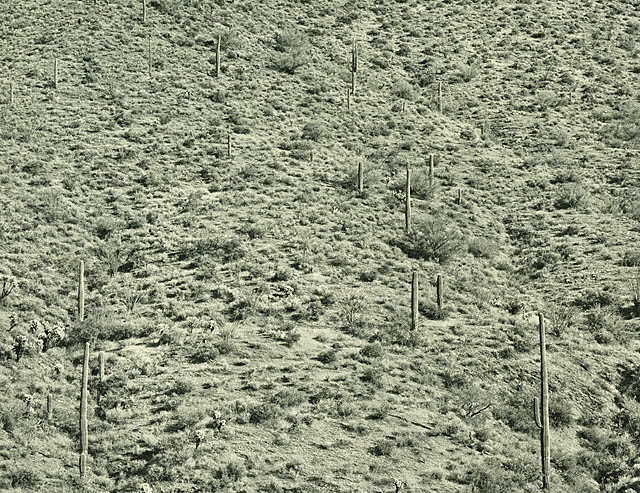 Frederick Sommer, Arizona Landscape 1945, Gelatin silver print
Sommer’s interpretation of the landscape that is at odds with the fundamentally positive view of the American West of many other photographers in that it represents the dark underbelly of American landscape photography--a land if dry, dead and dying.
|


