|
September 11, 2003
Rick's eighteenth post on Susan Sontag's Regarding the Pain of Others addresses the issue I raised in my previous post. about making sense of the haunting. Sontag argues that we need a special space to make sense of the haunting in us from the horrific images that we cannot, or should not, forget.
What has been quietly forgotten by Sontag is key idea of the left aesthetic tradition that has its roots in Schiller, Marx and Morris. The idea here is that in a disorderly, chaotic and contradictory world art holds out to us an image of how a better world might be. That is a core part of the German aesthetic tradition: it is reaffirmed by Adorno when he argues that modern art's cognition can keep alive the hope for a better life in a les damaged world by saying no to the present.
Sontag does not go as far as that, nor does she connect that tradition to our aesthetic experience of being haunted. Her argument is about the need for space to contemplate the searing images:
"Certain photographs – emblems of suffering…can be used like memento mori, as objects of contemplation to deepen one’s sense of reality; as secular icons, if you will. But that would seem to demand the equivalent of a sacred or meditative space in which to look at them. Space reserved for being serious is hard to come by in a modern society, whose chief model of a public space is a mega-store…It seems exploitative to look at harrowing photographs of other people’s pain in an art gallery….A museum or gallery visit is a social situation, riddled with distractions, in the course of which art is seen and commented on.” (Sontag, pp. 119 – 121)
So we need some sacred space away the art gallery or the megastore to give meaning to the images of the pain of others through making our aesthetic judgments.
I think more is needed than a space, however crucial that space is. What is been presupposed in this is the 'I', the humanist subject who morally responds to the searing images. Somehow the humanist subject has not been ravaged by the horrors. But look at the untitled image that Rick juxtaposes to this text:
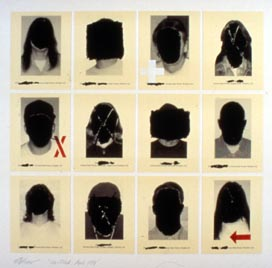
Rick Visser, Untitled
The subject has been ravaged. Our individuality has gone. We are faceless.
What stands over against us is a self-regulatory economic and political system that appears to be thoroughly rationalised. This system is pretty indifferent to the suffering of human beings caused by the frequent busts and depressions . It appears to be a second nature, divorced from human practice and self-evidently given.
We are damaged by this system ---eg., the effects of poverty caused by people being thrown out of work. See here and here.The subject may be so damaged that they are not capable of morally responding to the searing images of the pain and suffering of others. Some of us may be haunted and even enjoy the suffering of others, such as the Iraqi's.
previous post. Next Post
|


