|
November 24, 2012
Dusan Marek was a migrant European (Czech) surrealist in the post-war climate of Australia, which was tantamount to openly professing a belief in communism. Conservative Adelaide was hostile to his work.
The days of radical (modern) art in early 1940s when the original Contemporary Art Society in Adelaide had been formed by artists such as Douglas Roberts, David Dallwitz, Ivor Francis, Jeffrey Smart and Ruth Tuck had gone. Cultural conservatism ruled and it had no time for surrealism or communists.
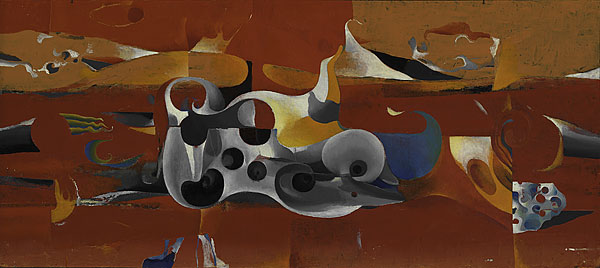 Dusan Marek, Summer In Coorong, 1971, oil on canvas
Marek was not a Czech surrealist in exile, as he was fascinated by the Australian landscape and the coastline. The style that developed was a merging of his own surrealist iconography with abstraction and abstract expressionism.
Marek is an indication that though WW2 is often taken to signal the decline of surrealism, it continued to exist as a historically decisive artistic tendency and experience in Australia.
We can talk about the Australian surrealists and it was more than the Angry Penguins magazine and the group founded in 1940 by the literary critic Max Harris; or the painters Albert Tucker, Sidney Nolan, Joy Hester and Arthur Boyd. That conventional art history narrative ignores the postwar European migrants.
|


