|
November 21, 2012
Jeffrey Smart and Jacqueline Hick visited Cradock near Hawker during 1945, painting the sunburnt countryside wracked with drought – stark outposts of survival.
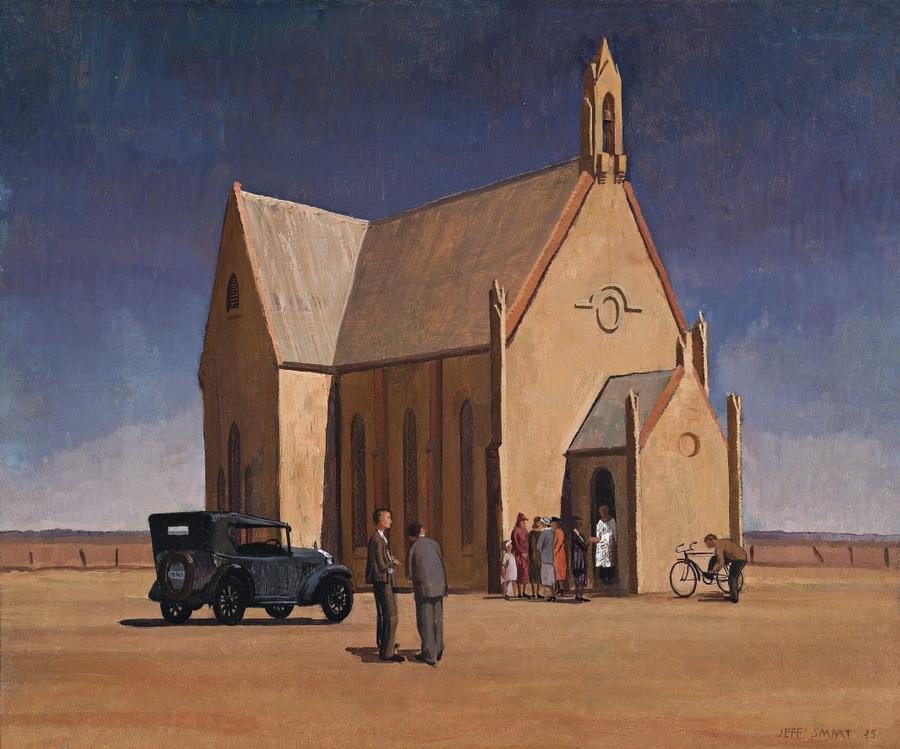 Jeffrey Smart, Sunday Morning Service, 1945, oil on canvas
In 'Sunday Morning Service' Smart makes the horizon low and long in the best surrealist tradition, heightening the isolation and verticality of the church and its presence, gothic in the vastness of the countryside. Everything is utterly still, like a still from a movie, while the shadows cast in the bright sunlight whisper of that which is not seen. The people, the car and bike are motionless in that atmosphere of expectation and piercing clarity that precedes a storm, heralded by the pulsating purple of the sky.
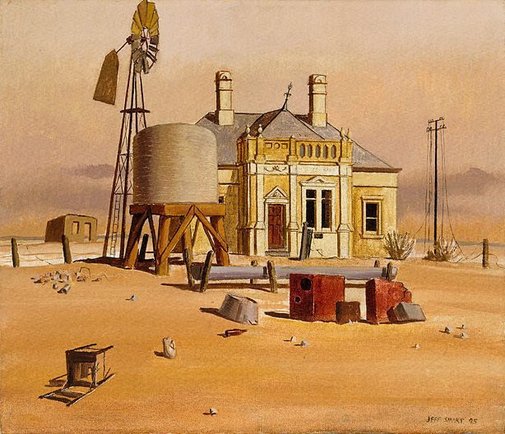 Jeffrey Smart, Wasteland 11, 1945, oil on canvas
Other paintings from this period that express the surrealist concern of an imaginative transformation of reality include 'Keswick Siding' 1945 and 'Kapunda Mines' 1946.
Smart's early work indicates that surrealism was not just a literary movement set by the theoriests (Breton) and litterateurs (Aragon), that the visual arts play second fiddle, and that surrealism was not rooted in pictorial concerns whose roots are in the idea of the poetic image.
|


