|
September 29, 2014
Hiroshi Sugimoto's series on iconic modernist architecture is structured around blurring the image. This was achieved by pushing his old 8x10 large-format camera’s focal length out to twice-infinity―with no stops on the bellows rail. The view then becomes an utter blur.
The landmarks of modern architecture have an enigmatic presence. The landmarks include Philippe Starck's Asahi Breweries, the Fujisawa Municipal Gymnasium by Fumihiko Maki, the United Nations Building by Wallace Harrison et. al., William van Alen's Chrysler Building, the Santelia Monument Como by Giuseppi Terragni, Minoru Yamasaki's World Trade Center, the Seagram Building by Ludwig Mies van der Rohe, E.U.R. San Pietro e Paolo by Marcello Piacentini and Antonio Gaudi's Casa Batlló II.
The blurred forms evoke the passage of time, muting the architectural details:
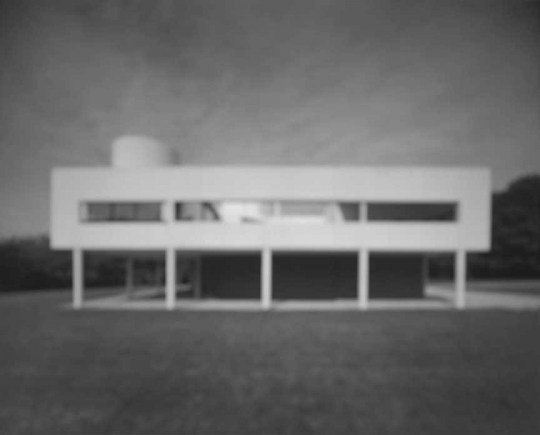 Hiroshi Sugimoto, Villa Savoye, Le Corbusier," 1998, Gelatin-silver print
In this series he is photographing huge-scale architecture, looking up from the ground level to develop a sense of seeing the building from the ground floor.
Sugimoto has made a strong impact on contemporary photography. His minimalist black-and-white images, each exploring a different theme and created according to a precise protocol, are studies in silence, clarity and emptiness. He achieves an exquisite range of tones in a body of work that reflects a great love of detail, an exceptional technical ability, and a fascination with the paradox of time. It is essentially minimalist as his compositions are spare and his basic forms uncomplicated.
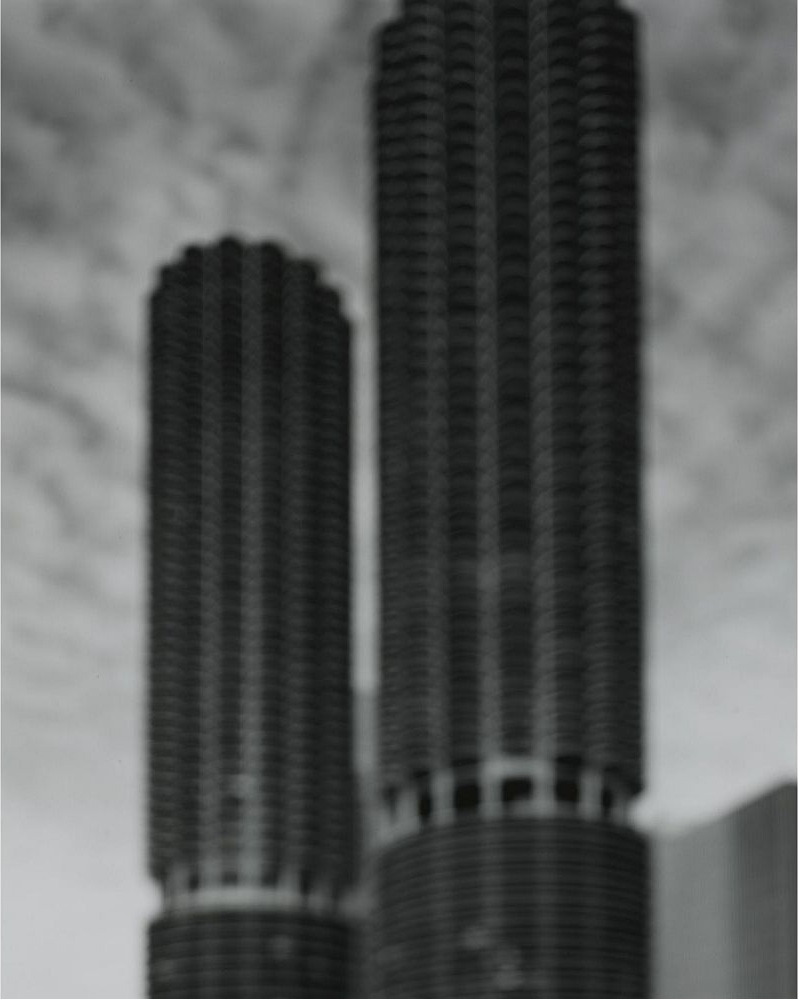 Hiroshi Sugimoto, Marina City, Le Corbusier," 2001, Gelatin-silver print
These buildings are isolated from their contexts. As a result of camera angle and of blurring, each structure is made to loom up in all its stark particularity as though out of nothing. In an ironic twist, the viewer ends up contemplating the structure for its lack of detail;
|


